
Services
Services, capabilities and terms
A quotation has three parts: Master Pattern, Mould, then Cast and Patina. Payment is staged across three points, starting with the master pattern paid in full before any work begins. Price is set by the difficulty of moulding, casting and chasing the piece, never by its weight.
01 · What we take on
What we take on
- Sculpture and decorative work in silicon bronze or brass
- Commissions from an idea, a drawing or a 3D file
- Master pattern making by our own designers and sculptors when a client has only a concept
- Editions, including edition closure and mould disposal
- Single pieces, with a longer lead time
- Reproduction of an existing physical piece, where the client has the right to reproduce it
02 · What we refuse
What we refuse
Machinery, industrial components and production hardware. Sculpture and decorative work only. This is a standing position and it is not negotiable by budget.
03 · Inputs we accept
Inputs we accept
Three, and any one of them is enough to start.
An idea. A description, a reference image, a rough sketch. Our own designers and sculptors will build the master pattern from it. This is the longest route and the one that most needs the client present during the master pattern stage.
A drawing. Elevations, dimensions, a rendering. We will tell you what has to change to make it castable before anyone commits.
A 3D file. Usable directly toward a master pattern. Note what a 3D file is and is not: it can produce a pattern, it cannot produce a bronze. See can I 3D print this instead of casting it.
04 · The quotation
The quotation, in three parts
1. Master Pattern. The original three dimensional model. Made by hand, or developed from your file or drawing. This is where the sculpture is decided.
2. Mould. The silicone mould taken from the approved master pattern. You pay for it and you own it. See who owns the mould.
3. Cast and Patina. The casting itself, all the chasing and welding, and the finished patinated surface.
Splitting the quotation this way means you can see what you are paying for at each stage rather than receiving one number for a three month project.
05 · Payment
Payment, in three stages
| When | What is paid |
|---|---|
| Before any work begins | 100% of the Master Pattern |
| On confirmation of the master pattern | 100% of the Mould, plus 50% of the Casting |
| Two weeks before pickup | The remaining 50% of the Casting |
We publish these terms deliberately. They are the same for everyone, and knowing them before making contact saves both sides a conversation.
06 · Pricing
Price is set by difficulty, never by weight
This is the term most often misunderstood, so it is worth being direct about it.
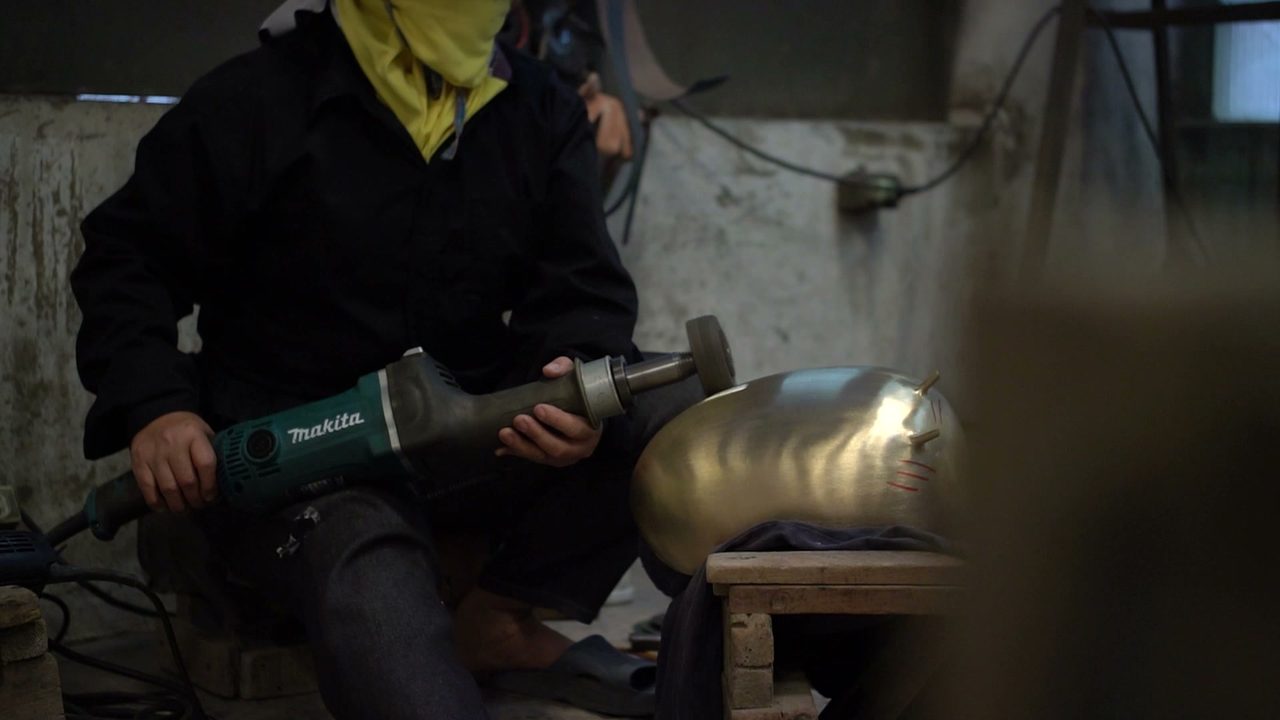
A per kilogram price is a commodity price. It says that two objects of the same mass cost the same, which is true for raw metal and false for sculpture. An undercut that forces the piece to be divided and welded back, a thin section that the metal struggles to fill, a surface with texture that has to be chased by hand across every square centimetre: none of those add weight, and all of them add days.
So the price of a casting here reflects how hard it is to mould, to cast, and to chase. That is why a light, intricate piece can cost more than a heavy, simple one, and why we can give a meaningful range only once we know the form and the size, not just the dimensions.
07 · Lead time
Lead time
Three months, starting after the master pattern is approved and the deposit is paid. Not from first contact, and not from the day a file arrives.
A single piece takes longer than a piece in a batch. Wax burnout and the crucible both run more economically with volume, so a lone casting waits for a run it can join. This is an honest constraint of the method rather than a scheduling preference.
08 · Scale
Scale
The crucible holds 500 kg. The largest work to leave this foundry stands seven metres, a pagoda, cast in sections and assembled by hand rather than poured in one piece.
That last detail is the part worth understanding, because it is what actually governs a large commission. A work at seven metres cannot be poured in one piece today. So the question we ask about a large project is not how tall it is. It is whether the form can be divided sensibly, cast in parts, and welded and chased back until the joins disappear.
Most forms can. Some cannot without compromising the sculpture, and when that is the case we would rather say so during the feasibility estimate than three months into the work.
09 · Packing and export
After the patina: packing, crating and export
This section exists because it is usually the part nobody answers, and for a buyer outside Thailand it is often the part that decides whether the project happens at all.
The craft is rarely the worry. The logistics are. Getting a heavy bronze from a workshop in Nakhon Pathom to a gallery, a lobby or a garden on the other side of the world sounds like a problem you will be left to solve alone from several thousand kilometres away. You will not be.
1. Finishing out. A final sealant is applied over the cured patina before anything is packed.
2. Packing. Standard pieces are packed in a carton with bubble wrap.
3. Crating. Larger pieces are packed in a wooden crate, built for the piece.
4. Fumigation and the customs stamp. Timber crates are fumigated and stamped here at the foundry, certified for international shipping. Not sent elsewhere for it, and not left for you to arrange at the port.
That stamp is the thing customs actually looks for. Untreated or unmarked wood packaging is the classic reason a shipment is held, refused or destroyed at the border, and it is a problem that surfaces after the piece has left the country, when it is expensive and slow to fix. Ours leaves here already carrying the mark, which is why the crate is part of the job rather than an afterthought.
5. Export documentation. For export orders we handle the documentation, working with an export partner.
6. Collection or shipping. Collect from the workshop, or we arrange transport.
How this fits with Ex Works pricing
These two facts look contradictory at a glance, so here they are side by side:
| The price is quoted Ex Works | It covers the finished piece at our gate in Nakhon Pathom. Freight, insurance and duty at the destination sit outside it and are quoted separately. |
| The capability is not limited to the gate | Crating, fumigation and export documentation are things we do, as services, on top of the casting. |
The price excludes freight. The capability does not. Ex Works describes where the casting price stops, not where our involvement stops. Quoting that way keeps two foundry prices genuinely comparable and keeps transport an honest, visible line rather than a padded one hidden inside the casting figure.
You can also hand collection to your own freight agent at any point, and the casting price does not change.
Tell us the destination during the feasibility estimate and the packing, crating and transport get quoted alongside the casting rather than after it.
What is not claimed here
We are not naming an export partner, we are not listing countries served, and we are not naming freight modes or transit times. We also do not quote a certificate number or a registration number against the crate stamp, because a number on a website is checkable and ours is not published anywhere we can point you to. Those depend on the piece, the destination and the day, and a website is the wrong place to promise any of them. Ask during the estimate and you will get a real answer for your actual project.
10 · Starting
Starting
The fastest way to find out whether a project is a fit is a feasibility estimate: the idea, the size, and roughly how many, and we will tell you whether it is castable, in which metal, and roughly what range it sits in.
11 · Common questions
Common questions
How is a Deco Foundry quotation structured?
In three parts. Master Pattern, which is the original model. Mould, which is the silicone mould taken from the approved master pattern. Cast and Patina, which is the casting itself and the finished surface.
What are the payment terms?
Three payments. The master pattern is paid in full in advance, before work starts. On confirmation of the master pattern, the mould is paid in full together with half of the casting. The remaining half of the casting is paid two weeks before pickup.
Why is the master pattern paid in full up front?
Because it is the stage where all the design work, all the revisions and all the client decisions happen, and it produces a physical object specific to one client. It is the largest concentration of skilled labour before any metal is involved.
How is the price calculated?
By the difficulty of moulding, casting and chasing the piece. Not by weight. Two pieces of identical weight can differ enormously in price, because an undercut, a thin section or a highly worked surface costs hours in chasing that a simple form does not.
Do you charge by the kilogram?
No. Pricing by weight rewards mass and ignores skill, and it produces the wrong answer for sculpture. It is the right model for a commodity supplier and the wrong one for an art foundry.
What do you need from me to start a quotation?
An idea, a drawing or a 3D file, plus the size you want and how many pieces. Any of those three inputs is enough for us to tell you whether the project is feasible and roughly what range it sits in.
What is the largest piece Deco Foundry has cast?
A seven metre pagoda, cast in sections and assembled. A work at that scale cannot be poured in one piece today, so for a large commission the governing question is whether the form can be divided, cast in parts, and welded and chased back so the joins disappear.
Do you ship, or does the client collect?
We can arrange shipping of any kind, domestic or international. Prices are quoted Ex Works, so the quoted figure covers the finished piece at our gate in Nakhon Pathom and transport is quoted separately on top.
What does Ex Works mean for me as a buyer?
It means the casting price stops at our gate and transport is a separate line rather than a hidden one. You can ask us to arrange the shipping, or use your own freight agent, and the casting price is the same either way. It also makes two foundry quotations genuinely comparable, because both stop at the same point.
How is a finished piece packed?
A final sealant is applied after the patina, then the piece is packed in a carton with bubble wrap. Larger pieces are packed in a wooden crate instead, and the timber is fumigated here at the foundry.
Do you crate large pieces?
Yes. Larger work is packed in a wooden crate built for the piece rather than in a carton, and the timber is fumigated at the foundry.
Do you handle export paperwork, or do I have to?
We handle it. For export orders we take care of the documentation, working with an export partner.
Is your wood packaging certified for international shipping?
Yes. Timber crates are fumigated and stamped at the foundry, certified for international shipping and for customs inspection. That stamp is what customs looks for, and unmarked wood packaging is a common reason shipments are held at the border.
If prices are Ex Works, does that mean I have to organise crating and export myself?
No, and the distinction is worth being clear about. Ex Works describes where the casting PRICE stops, which is our gate in Nakhon Pathom. It does not describe where our involvement stops. Crating, fumigation and export documentation are services we provide on top, quoted separately rather than folded into the casting price.
Will you cast machinery or industrial parts?
No. We cast sculpture and decorative work only.
Last reviewed:
Get a feasibility estimate
Tell us the idea and the size. We will tell you whether it is castable, in which metal, and roughly what range it sits in.