
About
About Deco Foundry
Deco Foundry Co., Ltd. was registered on 19 January 1993 in Sam Phran, Nakhon Pathom, and has cast continuously since. More than twenty people work in the shop, and every stage of the work happens there: design, master pattern, silicone mould, wax, ceramic shell, pour, chasing, welding and patina. Nothing is sent out.
01 · The company
The company
Deco Foundry Co., Ltd. (บริษัท เดอโก ฟาวดรี จำกัด) was registered on 19 January 1993 and has cast continuously since. The workshop is in Sam Phran, Nakhon Pathom, about an hour west of central Bangkok.
- Registered
- 19 January 1993
- Method
- Lost wax casting only. No sand casting.
- Metals
- Silicon bronze and brass
- Crucible
- 500 kg
- People
- More than twenty
- Visits
- By appointment only. No walk-ins.
02 · Everything happens here
Everything happens here
Design, master pattern, silicone mould, wax assembly, ceramic shell, burnout, pour, shell removal, cutting and welding, chasing, patina, packing. All of it, in one building, by people on our own payroll.
That matters commercially for two reasons.
It is why we can photograph your piece at every stage. Clients get email, photographs and video as the work progresses, which is how we stay in contact with someone we may never meet in person. You can only document every stage if every stage is happening under one roof.
It is also the answer to the confidentiality question. A design that never leaves the building cannot leak from a subcontractor's workshop, because there is no subcontractor. Anyone who has sourced overseas knows why that matters. The full answer is on will my design be copied.
03 · What we do not do
What we choose not to do
We do not cast machinery, industrial components or production hardware. Sculpture and decorative work only.
This is a positioning choice, not a capability gap. Industrial casting rewards throughput and dimensional tolerance. Art casting rewards the edge of a lip, the straightness of a line, the way a curve resolves. Those are different workshops, staffed differently, measured differently. We chose one.
An art foundry and a parts foundry optimise for different things, and a workshop that chases a bronze face for three days is not the right place to make a valve body.
04 · What we are good at
What we are good at
Three things, in the order clients tend to notice them.
Detail. Sharp edges that stay sharp, straight lines that stay straight, curves that hold their tension after chasing. Most of the difference between a good cast and a mediocre one is decided in chasing and welding, which is also the slowest stage.
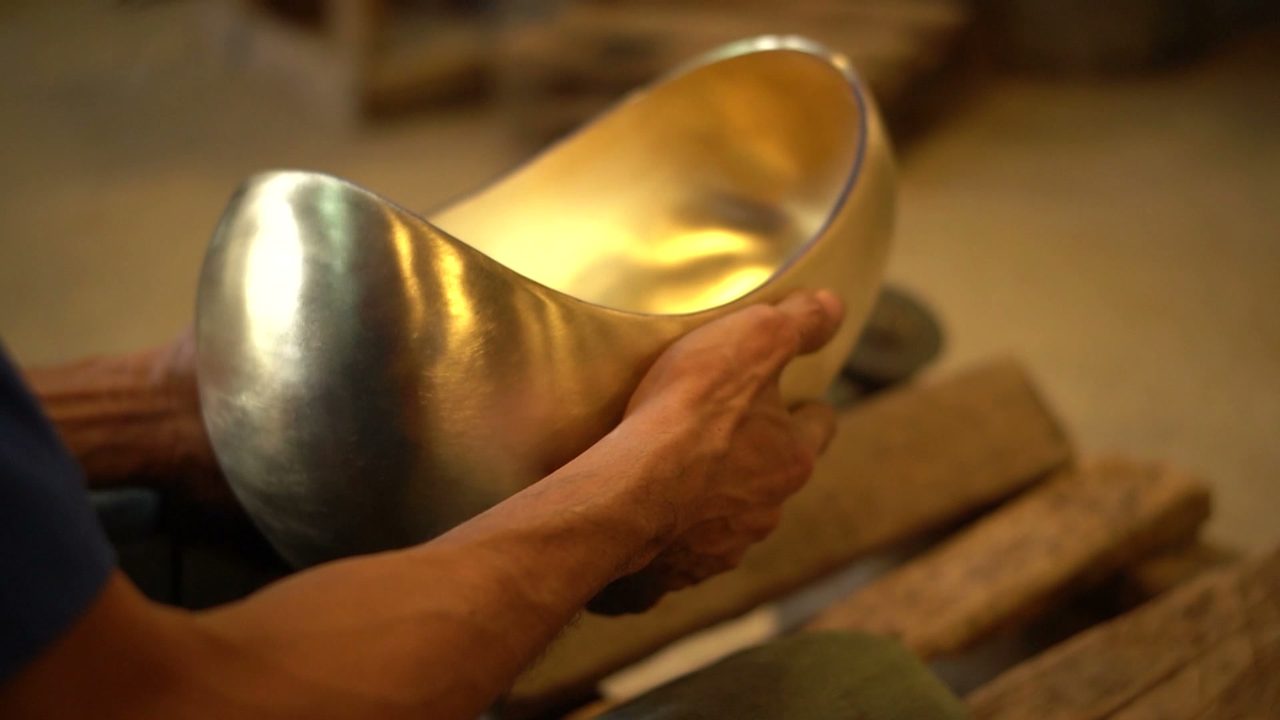
Reading a design. A drawing or a 3D file is not yet a castable object. Someone has to decide where the piece is divided so the shell can be built and the metal can flow, and where those divisions are welded and chased back so they disappear. Done well it is invisible. Done badly it is the first thing you see.
Staying in contact. Photographs and video at each stage, not a three month silence followed by a crate.
05 · Clients
Clients
Most of our work is domestic Thai: developers, exporters, sculptors and galleries. We have also cast continuously for an export brand supplying European distributors for over thirty years.
06 · No client list
Why you will not find a client list here
We do not publish the names of the people we cast for.
That is a deliberate position rather than an absence of work. A foundry's client list is a map of who commissioned what, and for a gallery, a sculptor or a developer that information can be commercially sensitive in ways that have nothing to do with us. We would rather be the workshop that does not publish it. It is the same commitment described on will my design be copied, applied to the paperwork instead of the mould.
What we can tell you is what has come out of the building.
The largest work to leave this foundry stands seven metres. It is a pagoda, cast in sections and assembled by hand, because a work at that scale cannot be poured in one piece today. No client is named in that sentence and none needs to be. It describes what the workshop can do, which is the part that is any use to you.
If a client does want the credit, we are glad to give it. Several simply prefer not to, and that preference is the point.
07 · Visiting
Visiting
By appointment only. We do not take walk-ins. That is partly a safety matter, since there is a furnace and molten metal in the building, and partly because a useful visit needs the right stage of the right job to be happening while you are standing there.
Arrange a visit through contact.
08 · Common questions
Common questions
How long has Deco Foundry been operating?
The company was registered on 19 January 1993 and has cast continuously since then.
How many people work at Deco Foundry?
More than twenty, covering design, master pattern making, silicone moulding, wax, ceramic shell, furnace, chasing, welding and patina.
Which parts of the work are subcontracted?
None. Every stage happens in our own workshop, from the master pattern through to the patina and packing.
Can I visit the foundry?
Yes, by appointment. There are no walk-in visits. Contact us first and we will arrange a time.
What is the largest piece Deco Foundry has made?
A seven metre pagoda. It was cast in sections and assembled by hand rather than poured in one piece, because a work at that scale cannot be poured in one piece today.
Why does the site not name any clients?
Because a client list is a map of who commissioned what, and that can be commercially sensitive for a gallery, a sculptor or a developer in ways that have nothing to do with us. We publish what has come out of the building instead. Where a client wants the credit, we are glad to give it.
Does Deco Foundry work with clients outside Thailand?
Yes. Most work is domestic, and we have cast continuously for an export brand supplying European distributors for over thirty years.
Last reviewed:
Get a feasibility estimate
Tell us the idea and the size. We will tell you whether it is castable, in which metal, and roughly what range it sits in.