
Process
How a piece is made, stage by stage
A piece passes through eleven stages: master pattern, silicone mould, wax pattern, wax assembly, ceramic shell, burnout, pour, shell removal, cutting and welding with chasing, patina, then finishing out and packing. Two separate moulds are involved. The silicone mould makes the wax and is reused. The ceramic shell is built fresh around each wax and is destroyed in every pour.
01 · The approval gate
The gate that matters most
Every change to the sculpture happens during the master pattern stage. Once the master pattern is approved, the form is fixed.
This is not small print, and it is not a way to avoid work. It is a physical fact of the method. The approved master pattern is what the silicone mould is taken from, and the silicone mould is what every wax comes out of. Change the sculpture after that point and there is nothing to change: the master pattern has to be reworked and the sequence restarted from stage one.
So the master pattern stage is where a client should be slow, demanding and difficult. Look at it from every angle. Ask for more photographs. Say the thing you are not sure about. After approval, the honest answer to "could we just make the shoulder a little wider" is no.
02 · Two moulds, not one
Two moulds, not one
This is the single most useful thing to understand about lost wax casting, and it explains almost every timing question a client ever asks.
Reused
The silicone mould makes the wax. It is taken once from the approved master pattern and it is reused. This is the mould the client pays for and owns. See who owns the mould.
Destroyed every pour
The ceramic shell is built around the wax, and it is destroyed in every pour. It is built up coat by coat around one specific wax, fired, filled with metal, then broken off and thrown away. It exists for a single casting and never survives it. Before the pour, the finished shell is backed with plaster and bound with iron wire, which holds it stable until the metal goes in.
So when someone asks "you have the mould already, why is the second one not fast" the answer is that only one of the two moulds carries over. Everything from the wax onward happens again in full.
03 · Durations
How long each stage takes
| Stage | Duration | 0, 2, 4, 6 and 8 weeks |
|---|---|---|
| Master pattern | Client dependent. See below. | |
| Mould | 1 to 2 weeks | |
| Wax | 1 to 2 weeks | |
| Chasing, including assembly and welding | 1 to 2 months | |
| Patina | 1 to 2 weeks | |
| Finishing out and packing | Applied and packed once the patina has cured |
The master pattern stage has no fixed length, and that is not evasion. It depends on the design and on how long you take to approve adjustments. A client who responds quickly to photographs and is decisive about changes will move through it in a fraction of the time a client who is still deciding the pose. Since this is the stage where every change has to happen, the right amount of time to spend here is however long it takes to be certain.
Add the stages after approval together and you get roughly two to three and a half months, which is why the published lead time is three months from an approved master pattern and a paid deposit.
Read that range honestly. The low end of every row assumes the piece is straightforward and the shop has room for it. We quote three months because that is what a client can plan against, not because every stage always takes its maximum. We will not promise the bottom of the range, and you should be sceptical of any foundry that does.
Note which row is the long one. Chasing is one to two months on its own, and it includes assembly and welding. That single row is most of the calendar.
04 · The eleven stages
The eleven stages
- 01
Master pattern
The original three dimensional model of the piece, made by hand or from a client drawing, 3D file or concept. Every change to the sculpture happens here. Once the master pattern is approved, the form is fixed. The length of this stage depends on the design and on how quickly the client approves adjustments, so it is not fixed.
Approval gate. The form is fixed after this stage.
- 02
Silicone mould
A flexible silicone mould is taken from the approved master pattern. This is the mould that is reused, and it is the one the client pays for and owns. Typically 1 to 2 weeks.
- 03
Wax pattern
Wax is cast into the silicone mould to produce a wax copy of the piece. One wax is needed for every finished casting. Typically 1 to 2 weeks.
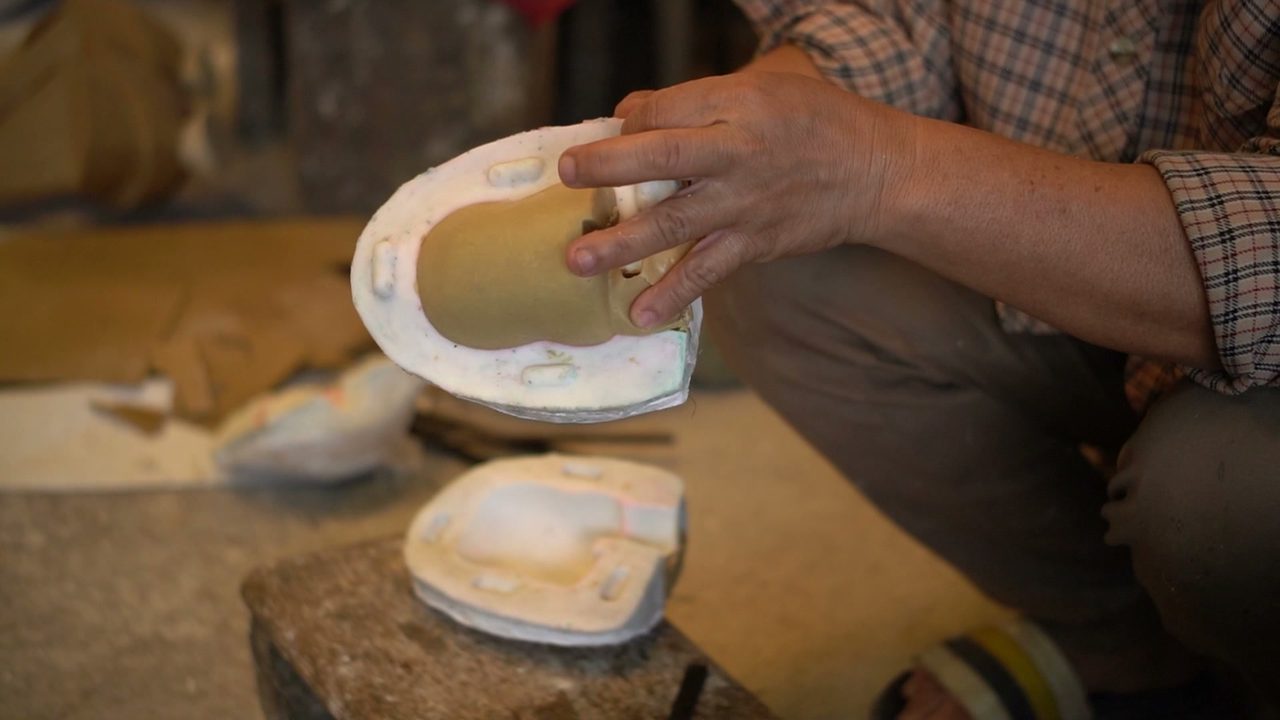
A wax pattern lifted out of its mould. - 04
Wax assembly
The wax is divided where required so the shell can be built and the metal can flow, then wax runners and feeders are attached. Where a piece must be divided, the divisions are planned so they can be welded and chased back invisibly later.
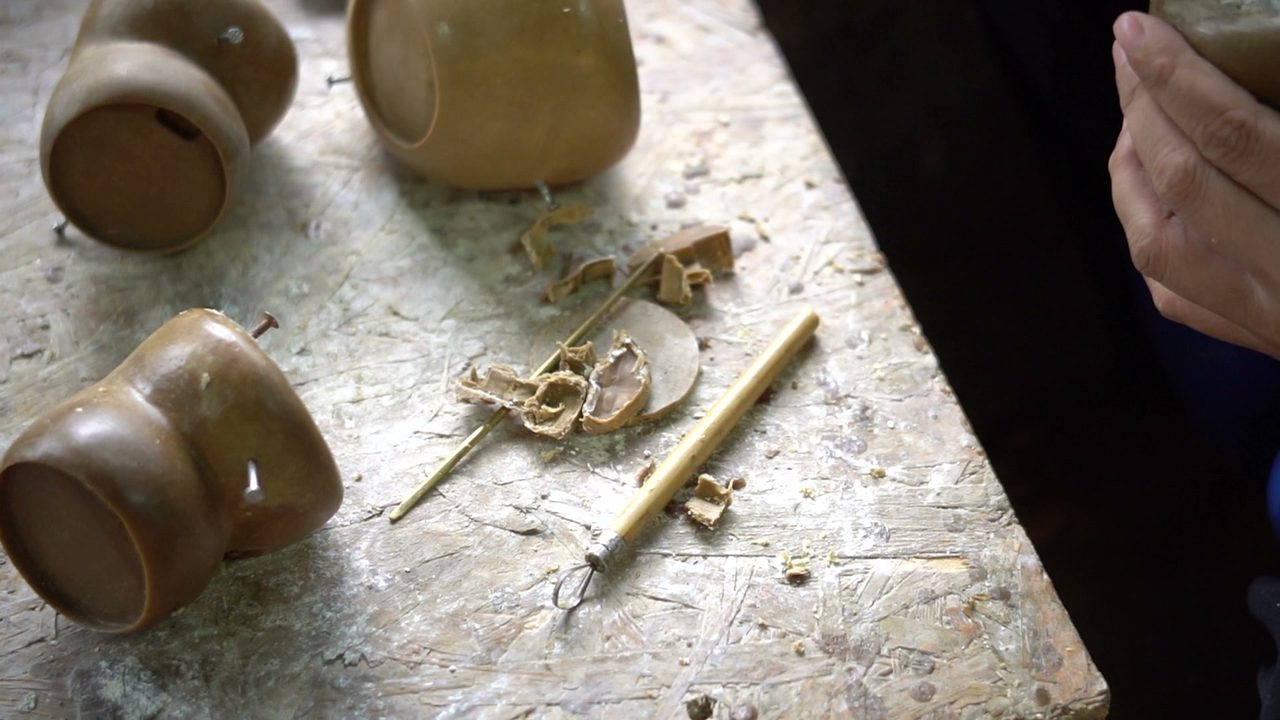
Wax patterns before assembly, with the trimmings and tools used to clean them up. - 05
Ceramic shell
The wax assembly is dipped repeatedly in ceramic slurry and stucco and dried between coats until a rigid shell has built up around it. This shell is made new for every single casting.
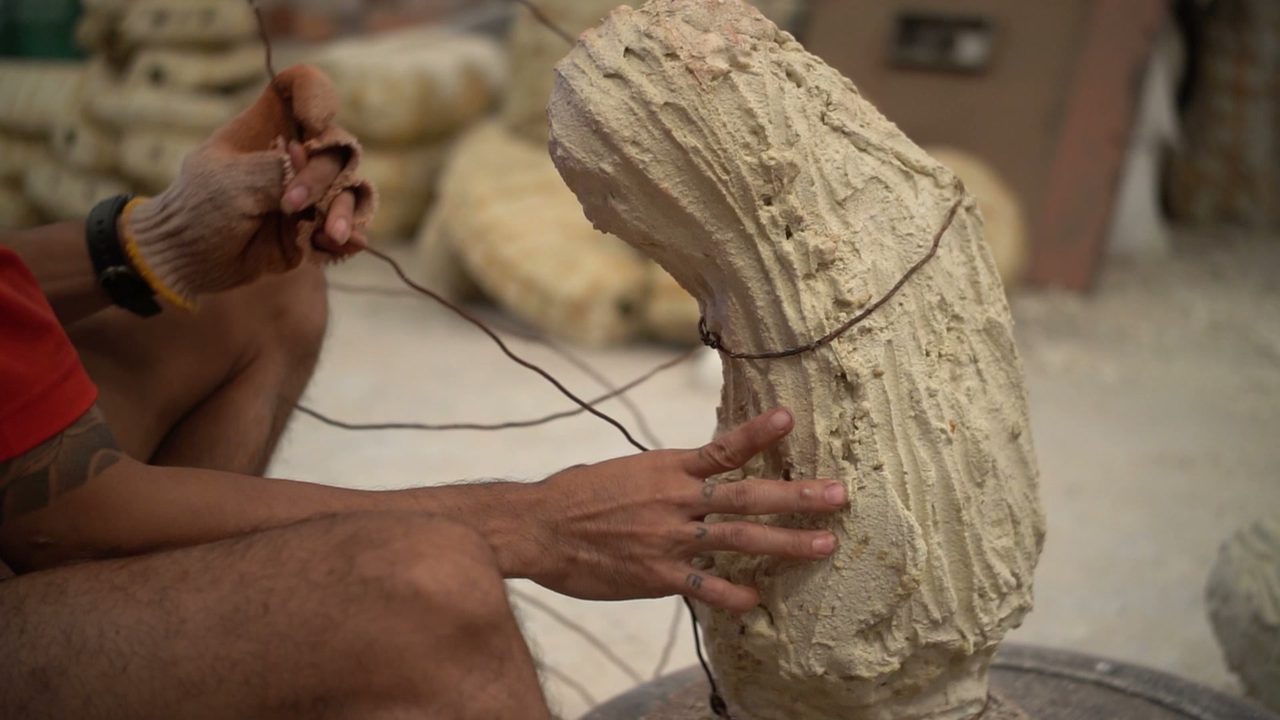
Plaster and iron wire reinforce the ceramic shell before the pour. - 06
Burnout
The shell is fired. The wax melts and burns out, leaving a hollow ceramic cavity in the exact shape of the piece. The wax is gone. This is why the method is called lost wax.
- 07
Pour
Molten silicon bronze or brass is poured into the hot shell and left to solidify.
- 08
Shell removal
The ceramic shell is broken away and discarded. It cannot be reused, which is why having cast a piece once does not make the next one quick.
- 09
Cutting, welding and chasing
Runners and feeders are cut away, divided sections are welded back together, and the whole surface is chased by hand until the joins and the casting texture are gone. Chasing includes that assembly and welding. Typically 1 to 2 months, which makes it the slowest stage of the entire process by a wide margin, and the one that decides how good the piece looks.
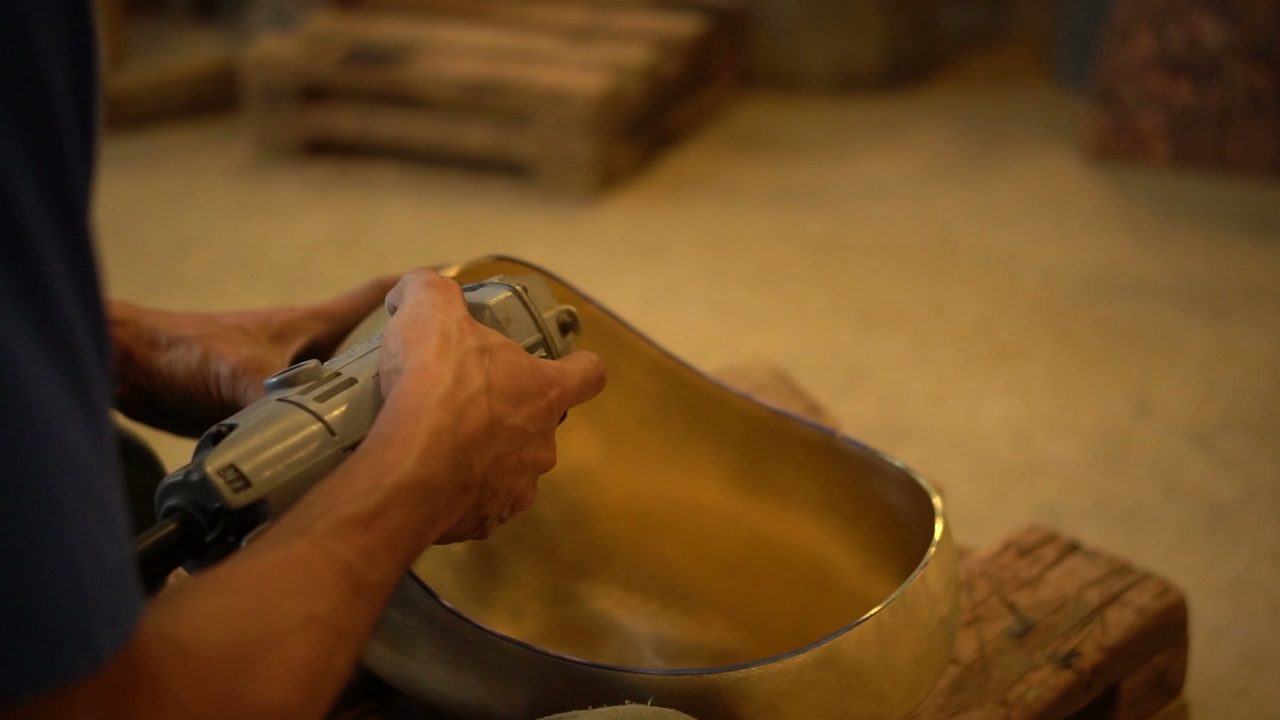
Chasing at the bench. This is the slowest stage of the whole process. - 10
Patina
The finished surface is chemically coloured. Patina is a chemical reaction with the metal, not a coat of paint. Typically 1 to 2 weeks.
- 11
Finishing out and packing
A final sealant is applied over the cured patina, then the piece is packed in a carton with bubble wrap ready for collection or for the transport we arrange.
05 · Chasing
Chasing and welding is the bottleneck
Not the pour. The pour is dramatic and it is over in under a minute.
Cutting off the runners, welding divided sections back together and chasing the surface by hand until the joins vanish is the slowest part of making a bronze, and it is where the difference between a good foundry and a cheap one actually shows up. A casting straight out of the shell is not a sculpture yet. It is a rough object with metal plumbing attached to it.
This is also why we price by difficulty rather than by weight. Two pieces of identical weight can need completely different amounts of chasing. See services.
06 · What you see
What a client sees during the three months
Photographs and video at each stage, by email. The workshop is closed to walk-in visits, so documentation is how a client stays close to a piece they cannot stand next to. Scheduled visits are welcome by appointment.
07 · Common questions
Common questions
Why are there two moulds in lost wax casting?
The silicone mould makes the wax copies and is reused. The ceramic shell is built around each individual wax and is destroyed when the casting is broken out. A foundry that already has your silicone mould still has to build a new ceramic shell for every piece it pours.
You already have my mould, so the second casting is quick, isn't it?
The silicone mould saves the master pattern stage, which is real and significant. Everything after it still happens in full: a new wax, a new ceramic shell, a new burnout, a new pour, and the same chasing and welding. Chasing and welding is the slowest stage and it does not get shorter with repetition.
Why does a piece have to be cut apart and welded back together?
Some forms cannot have a ceramic shell built around them in one piece, and some have paths the molten metal cannot fill in one flow. Those pieces are divided at planned points, cast as sections, then welded and chased back so the joins disappear.
When can I still change the design?
During the master pattern stage, and only then. Once the master pattern is approved and the silicone mould is taken, the form is fixed. Changing it after that means going back to the master pattern and starting the sequence again.
How long does each stage take?
The mould takes 1 to 2 weeks, the wax 1 to 2 weeks, chasing 1 to 2 months, and the patina 1 to 2 weeks, then a final sealant is applied and the piece is packed. The master pattern stage before all of that has no fixed length, because it depends on the design and on how quickly the client approves adjustments.
Which stage takes the longest?
Chasing, at 1 to 2 months. It includes assembly and welding, so on a piece cast in sections it covers putting the piece back together as well as working the surface. It is the bottleneck of the whole process.
What happens after the patina?
A final sealant is applied over the cured patina, then the piece is packed in a carton with bubble wrap for collection or for the transport we arrange.
What is patina?
A controlled chemical reaction on the surface of the metal that produces the final colour, then sealed. It is not paint and it is not a coating that sits on top of the piece.
Last reviewed:
Get a feasibility estimate
Tell us the idea and the size. We will tell you whether it is castable, in which metal, and roughly what range it sits in.